“We made a difference. We took care of people. People who are alive today because of us.” —Mitchell J. Brown, Former Freedom House Ambulance Service Paramedic
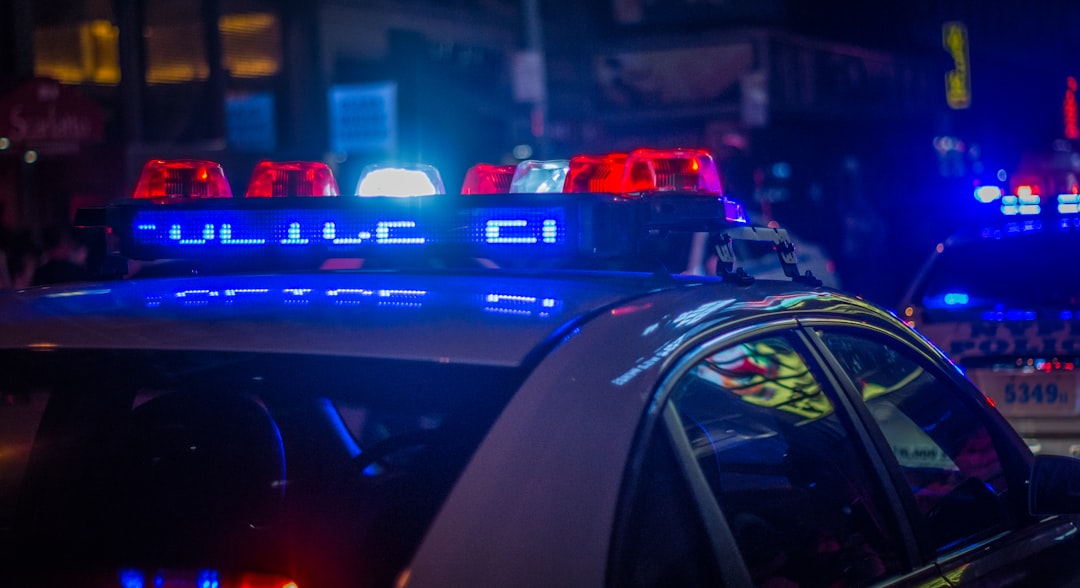
Photo by Michael Förtsch on Unsplash
What we’ve been taught about emergency response
We’ve watched storylines where police arrive first, take control, and resolve the situation. Over time, that narrative has shaped our expectations. So when someone calls 911, whether it’s for a mental health crisis, substance use emergency, or a moment of distress, we default to what we’ve been shown.
Police are sent, even when the situation isn’t criminal.
But the reality is, many emergencies aren’t about crime at all. They’re about mental, behavioral, or emotional health. And when the response doesn’t match the need, people can be met with harm and systems that weren’t designed to support them in the first place.
That disconnect is what this movement is working to change.
A new kind of show and the real-world movement behind it
Instead of centering law enforcement, it follows alternative first responders, trained professionals who respond to non-criminal emergencies with care, de-escalation, and connection to services.
They show up in homes, schools, and public spaces to support people experiencing:
-
Mental health crises
-
Substance use emergencies
-
Moments of acute distress
These responders are trained to assess what’s happening in real time, stabilize the situation, and help people access the care they need, whether that’s immediate support, medical attention, or longer-term services.
And importantly, they approach these moments as health emergencies, not criminal ones.
The series itself is grounded in truth. It draws from interviews with real response teams across the country—people already doing this work every day—and transforms those experiences into storylines, characters, and narrative arcs.
Using a scripted format allows the show to do two things at once: tell honest, complex stories while protecting the identities and privacy of the people whose experiences inspire them.
But this isn’t just about storytelling for awareness. It’s about showing people that this kind of response already exists and helping them find it.
From screen to system: The role of the Right Response
Across the country, alternative response is already a present reality. Through our Right Response Directory, we’ve identified more than 250 community responder teams nationwide. Based on ongoing research and outreach, that number may be closer to 600 programs operating across the U.S.
1M4 has been building and expanding this directory as a living resource, mapping what exists, elevating what’s working, and making it easier for people to access these services in their own communities.
These programs vary by location, but many share a common approach: small, multidisciplinary teams—often two to four responders—who bring a mix of expertise into the field.
-
Behavioral health specialists trained in crisis intervention
-
Emergency medical technicians and community paramedics
-
Licensed clinical social workers and therapists
-
Peer support specialists with lived experience
-
Outreach workers who maintain ongoing relationships in the community
Together, they respond to calls that don’t require police but care, expertise, and trust.
Our directory does more than list these programs. It creates visibility for a system that has often operated in the background and connects people directly to alternatives that align with their needs.
In tandem, this TV series will highlight the important work these responders do and point people directly to where they can find support.
Why this shift is gaining momentum
This isn’t a fringe idea. A lot of people across the country are already aligned on this approach.
Communities want our government to rethink how public safety works, not by replacing existing systems, but by improving them. That includes addressing the root causes of harm and more effectively matching the right professionals to each 911 call.
-
58% of voters support combining traditional policing with co-responder and alternative responder models
-
Strong agreement that public safety systems should send the right type of responder based on the situation
And when it comes to specific emergencies, the public is even more decisive. Voters consistently say police are least needed for:
-
Anxiety and panic attacks
-
Mental health distress calls
-
Environmental and quality-of-life concerns
In other words, the very situations that make up a significant portion of 911 calls are the ones where people most want a different kind of response. Importantly, this shift isn’t seen as political. It’s seen as practical.
Overall, people believe that expanding alternative response:
-
Improves outcomes for people in crisis
-
Builds a more effective, responsive system overall
-
Supports police by allowing them to focus on violent crime
At its core, this is about alignment, ensuring that when someone calls for help, the response they receive actually matches what they need.
We've done this before
If reimagining emergency response feels like a big shift, history reminds us it’s not unprecedented.
Before the late 1960s, there was no modern paramedic system in the United States. If someone had a heart attack, police were often the only option. People were transported without care, and many didn’t survive the trip.
That changed with the Freedom House Ambulance Service in Pittsburgh.
Staffed by Black women and men from the community, Freedom House responders became some of the first highly trained emergency medical technicians in the country. They brought care directly to people, delivering life-saving interventions before patients even reached the hospital.
Their work didn’t just improve outcomes. It transformed emergency response as we know it.
Today, we can’t imagine a world without paramedics. Alternative first response is part of that same evolution.
It recognizes that mental health and substance use crises are health emergencies, and that they deserve health responses.
From awareness to access
This is where everything comes together. The show changes perception. The research validates the shift. The history reminds us it’s possible.
Because awareness is only the first step, when people understand that alternatives exist, our expectations shift, and systems are pushed to evolve.
That’s how change happens, not all at once, but steadily, as more people see what’s possible and demand better alignment between need and response. We are in a moment where people are asking deeper questions about safety, care, and community.
And increasingly, the answer is clear: We don’t have to send police to every emergency. We can build systems that respond with care, dignity, and the right kind of expertise.
Call to Action
We’re very excited to bring this TV series to life and continue building momentum behind this work. If you’d like to be part of this journey, here are a few ways to support in the meantime:
-
Join 1M4 here and help us bring this series to televisions around the globe
-
Introduce us to any show creators, producers, or Hollywood execs in your network. Feel free to reach out via our email at info@1m4.org.
-
Explore our directory to find resources in your area
-
Learn what alternative response looks like in your community
-
Share the directory and information about emergency response alternatives with your family and friends
We’d love to hear from you. What do you think about the series? Drop your thoughts in the comments.
Your Sistas Through It All,
The Ladies of 1M4
A moment of reflection and mourning
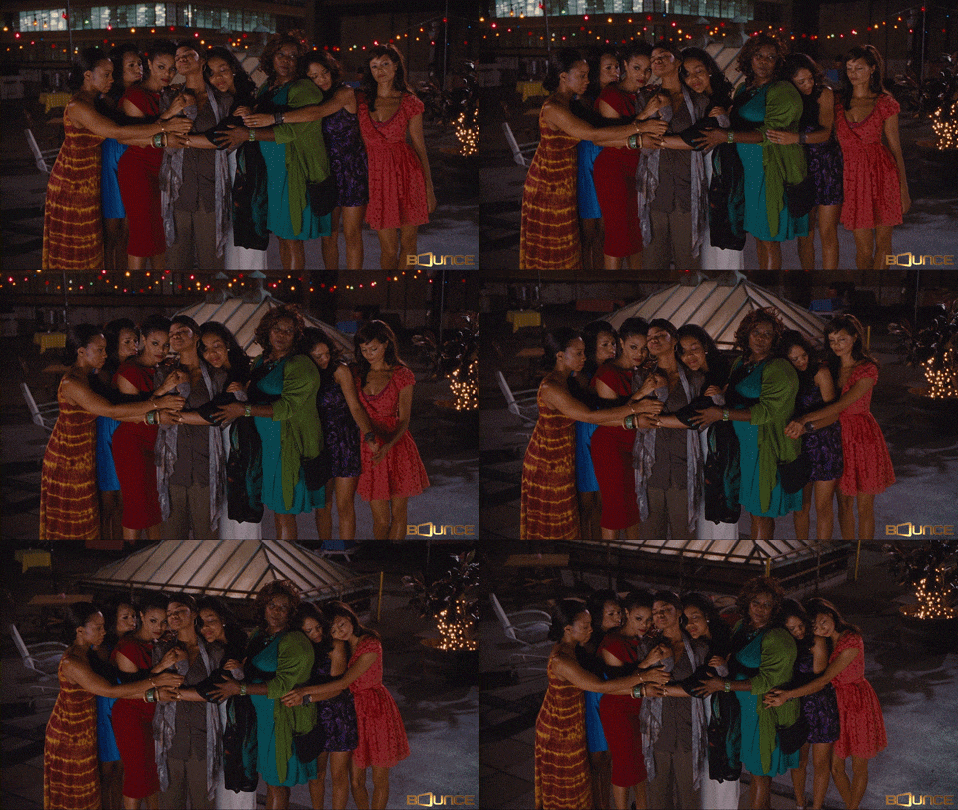
These past few weeks have been heavy.
We’ve witnessed the tragic murders of Black women by their partners.
Dr. Cerina Fairfax
Pastor Tammy McCollum
Vice Mayor Nancy Metayer
Ashly Robinson (aka Ashlee Jenae)
Qualeshia “Saditty” Barnes
Davonta Curtis
Barbara Deer
Ashanti Allen
Alongside these tragedies, we’ve also witnessed the devastating impact of a domestic violence–related shooting in Louisiana, where eight children were killed and their mothers injured.
We are holding all those affected and their families in our thoughts and prayers during this difficult time.
At 1M4, we believe in telling the truth with care. And the truth is: we cannot keep defaulting to “mental health” as the explanation for violence. Mental health matters, but it is not the full story. According to a 2015 comparative study, other countries experience mental health challenges too, yet the United States remains an outlier in lethal violence. Homicide rates here are over seven times higher than in other high-income countries, and firearm homicide rates are more than twenty times higher.
We also know that for women, the greatest danger is not a stranger. It’s someone they know. Intimate partners are the leading perpetrators of violence against women, underscoring that this harm is not random,
So this is a call in, not just a call out. To the men in our community and those who stand beside us: accountability lives in the everyday. It looks like calling out harmful language and behavior, challenging misogyny, and refusing to normalize the disrespect of Black women in your circles. It means choosing courage over comfort, especially when it’s someone you know.
Silence protects harm. Your voice can disrupt it.
And for all of us, this is a moment to care for ourselves and each other more intentionally. To check in, stay connected, and build the kind of community where intervention happens before crisis.
We honor those we’ve lost not just in grief, but in how we choose to show up next. Please know that we’re here for you, sharing resources and hosting gatherings that offer both comfort and critical information in moments like these.
A mental health tip for you

If you’re looking for additional support or want to help a loved one, explore our 1M4 Black Mental Wellness Resource Guide for trusted tools and support resources
Spread Some Blessings!
The consequences of police violence extend far beyond the loss of life. For families affected, it’s the loss of income, the sacrifice of basic necessities, and the start of a high-cost legal fight. If you have the capacity, consider donating to 1M4. Proceeds help support impacted families and sustain the work of 1M4 toward ending police violence for good.


To make sure our community has the tools to stay safe and support each other, our Founder, Tansy, holds weekly office hours to answer questions and walk members through 1M4’s safety resources.
No registration needed. Just join 1M4 via the button below, then hop into our online convos at 12 PM ET every Tuesday.
Got a pressing question? Send an email to info@1m4.org, and we’ll get back to you before the next session.
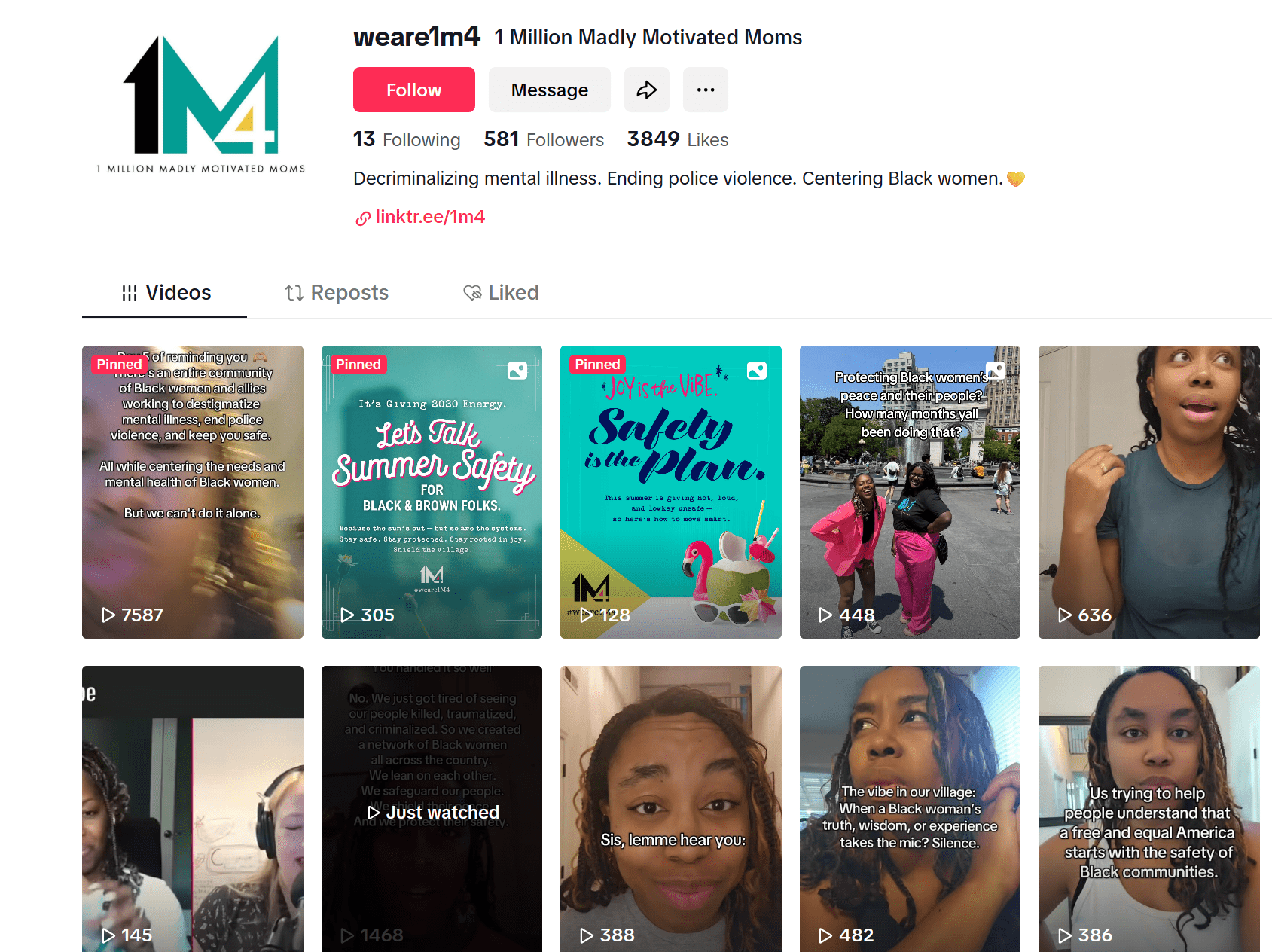
Ok so… we’re on TikTok now! Follow, engage, and rep 1M4 over there. We’re doing our best to reach the people.
Help some Sistas out!


You Got Your 1M4 Merch Yet?
Visit the 1M4 merch store to make sure you’re representing at court support, protests, or in line at your favorite coffee spot. We want to see YOU in your 1M4 gear. Every purchase goes directly to funding the work of 1M4 increasing access to safety and wellness.