
“You are free to blossom, to root yourself, and to soar.”
— Whitney, Dear Black Women

There’s a reason you feel safe gathered around your family at the cookout, chatting it up at the salon, or sharing laughs with your girls at dinner.
Something in your body shifts in those moments. Your shoulders drop, your breathing slows, and you feel a little more like yourself again.
That shift is not just emotional. It's physiological.
Your nervous system is always listening
Research in social neuroscience shows that positive social connection directly influences the nervous system through what is called co-regulation—the process by which one person’s calm state helps regulate another’s. When we experience safety through trusted relationships, the brain’s stress response system (the hypothalamic-pituitary-adrenal axis, or HPA axis) begins to downshift, reducing cortisol, the body’s primary stress hormone (Hostinar et al., 2014).
In plain terms: your body is constantly scanning your environment for cues of safety or threat. And other people are one of the strongest signals it reads.
This is why certain environments feel like exhale points. The salon. The cookout. The spaces and people who understand your lived experience, who can hold both your joy and your pain. In those moments, your nervous system is responding to something very real: “I am safe enough here to let go.”
Connection is biological
One of the key players in this process is oxytocin, often called the bonding hormone. Oxytocin is released during positive social interaction—like laughter, touch, shared storytelling, and emotional closeness. Studies show it helps reduce stress reactivity and supports feelings of trust and emotional safety (McQuaid et al., 2016).
What that means practically is this: connection doesn’t just feel good. It changes what your body is doing under the surface. It can lower heart rate, reduce cortisol levels, and shift the nervous system out of survival mode.
This is also where the idea of needing “8 hugs a day” comes from in popular wellness conversations—not as a strict rule, but as a shorthand for something deeper. Humans need repeated signals of safety and connection throughout the day:
A check-in text. A gathering. Sitting in the presence of people who know you without explanation. These are all biological inputs.
Why chronic stress changes the body
When stress becomes chronic, the body adapts. It learns to stay ready even when there is no immediate threat. This is part of what we call allostatic load, the cumulative wear and tear on the body from repeated stress activation over time (McEwen, 1998).
In the long term, this can affect sleep, mood, focus, immune function, and overall well-being. The nervous system becomes less able to fully return to baseline because it has been trained to stay alert.
And this is where community becomes more than culture. It becomes regulation.
Micro-moments of safety matter more than we think
Moments like taking a walk with a friend or playing with your kids are micro-experiences of safety.
Social buffering shows that even brief positive interactions can lower physiological stress responses, including cortisol levels. In other words, it’s not just long-term relationships that matter. The accumulation of small, repeated experiences of connection is also important.
The nervous system responds to quality, not just quantity.
A space where you can laugh freely.
A moment where you’re not explaining yourself.
A conversation where you are not performing strength.
What isolation does to the nervous system
On the flip side, emotional isolation has a very different effect. Without consistent relational safety, the nervous system does not receive enough cues to fully relax. It stays in a heightened state, even in everyday situations.
This does not always look like distress. Sometimes it looks like fatigue that doesn’t go away. Or irritability. Or feeling like you are always “on” even when nothing is happening.
Here are some simple and practical ways to address emotional isolation:
-
Create consistent, low-pressure touchpoints with others
A weekly check-in text, short call, or voice note exchange with a trusted friend or loved one helps signal relational safety without requiring heavy emotional labor. -
Prioritize shared presence over “deep” interaction
Being around others—walking with someone, co-working, sitting in a coffee shop—can calm the nervous system even without conversation. -
Name needs simply and directly in moments of connection
Phrases like “I just need company right now” or “Can I talk this out?” reduce the pressure to perform and make support easier to receive. -
Anchor into one steady community rhythm
A recurring class, group, or gathering creates predictable connection, which helps counter the body’s sense of ongoing isolation.
The reality for Black women: Always the regulator, rarely the regulated
For Black women, these dynamics carry another layer.
We are often the ones providing emotional stability for others. We notice everything. We hold conversations together. We anticipate needs before they are spoken. We become the steady presence in rooms that need grounding.
That capacity is powerful but exhausting. Because being the source of regulation for others does not automatically mean you are receiving it in return.
So many Black women are operating as emotional infrastructure—holding families, friendships, workplaces, and communities together—while still navigating their own stress in silence. And over time, that imbalance becomes too much.
What real community actually does for the body
This is where intentional spaces become essential. At 1M4, and in gatherings and check-ins like Tuesdays with Tansy, what is being created is not just conversation. Your nervous system is recalibrating. It is the experience of being in a room where you do not have to perform stability because safety is already present.
The body responds to that difference immediately, and the internal scanning quiets down.
Safety is a felt experience. And the science supports this: repeated experiences of safe connection help retrain the nervous system over time. Not through one moment, but through consistent relational patterns that signal “you can soften here.”
Why this changes everything
Our nervous system is shaped by connection. Which means community is not optional but foundational. It’s how our body regulates itself.
And for Black women, that truth is especially important to name. Because your body remembers what it feels like to be held in connection.
And the more we understand that, the more we can begin to treat connection not as something extra, but as something essential to how we live, heal, and sustain ourselves.
That’s what we aim to build at 1M4: a safe, intentional space for Black women to connect, be held, and build community together. If this resonates, we invite you to join us.
Your Sistas Through It All,
The Ladies of 1M4
Sista Spotlight:
April Stromas

Happy National Nurses Month and a big congrats to April Stromas on being accepted into an associate’s-level nursing program!🩺
April, your dedication to care, service, and showing up for others is exactly what this new chapter is about. We’re celebrating you as you take this next step toward a profession rooted in healing and impact.
Here’s to future Nurse April! Your journey is already inspiring so many of us.
A mental health tip for you

Photo by Sixteen Miles Out on Unsplash
It may be the last day of National Women’s Health Week, but we’re prioritizing our mental health all year long.
One simple but powerful practice: unfiltered journaling. Instead of trying to write something meaningful or organized, set a timer for 5–10 minutes and write exactly what’s in your head—no grammar, structure, or censoring.
The goal isn’t insight, it’s release. When thoughts stay looped internally, they can keep the body in a low-level stress state. Getting them onto paper helps create distance between you and the noise.
To make it even more grounding, end with one sentence that brings you back to the present, like: “Right now, I am safe enough to pause.”
Spread Some Blessings!
The consequences of police violence extend far beyond the loss of life. For families affected, it’s the loss of income, the sacrifice of basic necessities, and the start of a high-cost legal fight. If you have the capacity, consider donating to 1M4. Proceeds help support impacted families and sustain the work of 1M4 toward ending police violence for good.


As we focus on bringing our TV series to life, we continue to uplift the work of trusted community partners. On our website, you’ll find upcoming events hosted by these organizations so you can stay connected to the resources, conversations, and support you need.
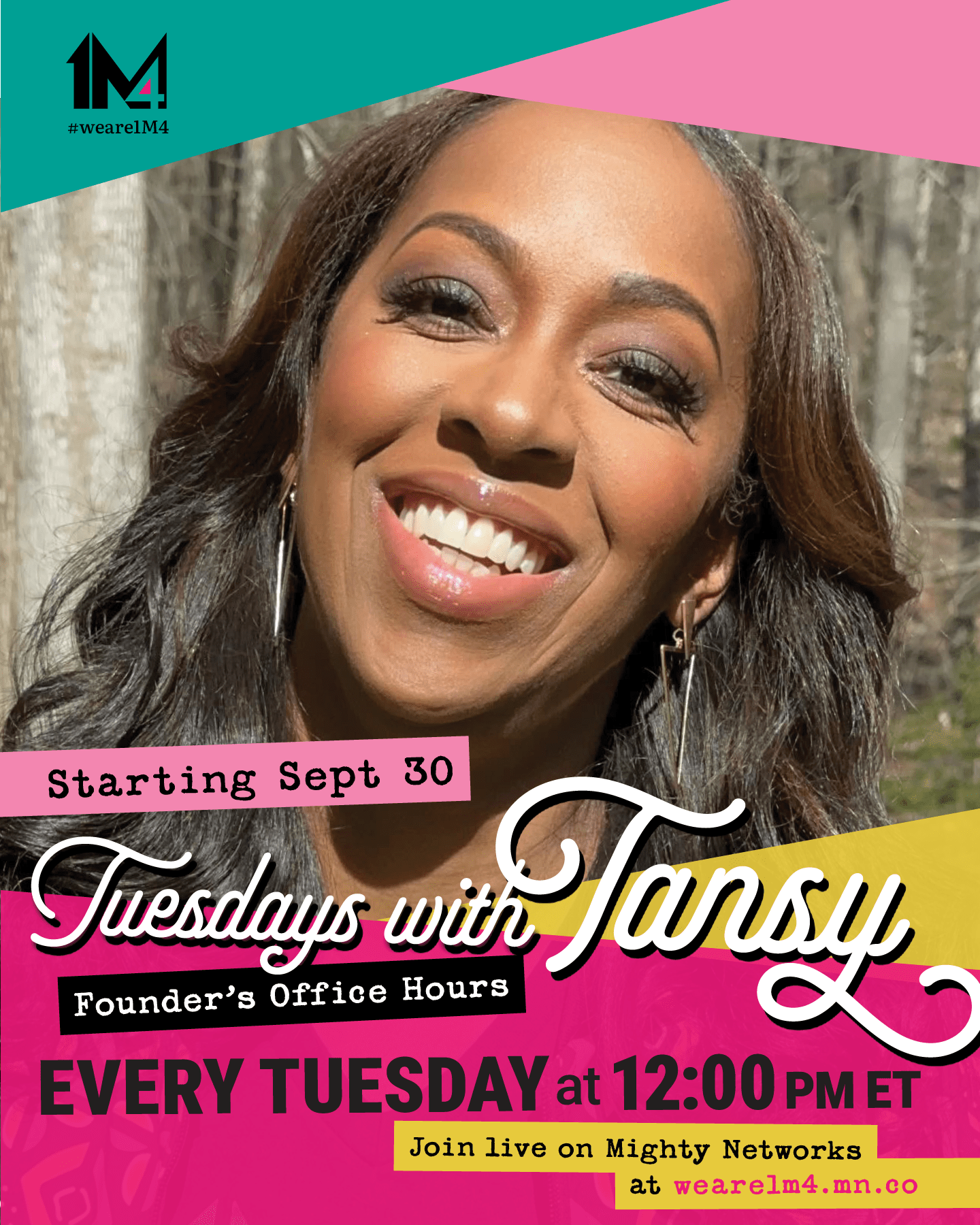
To make sure our community has the tools to stay safe and support each other, our Founder, Tansy, holds weekly office hours to answer questions and walk members through 1M4’s safety resources.
No registration needed. Just join 1M4 via the button below, then hop into our online convos at 12 PM ET every Tuesday.
Got a pressing question? Send an email to info@1m4.org, and we’ll get back to you before the next session.
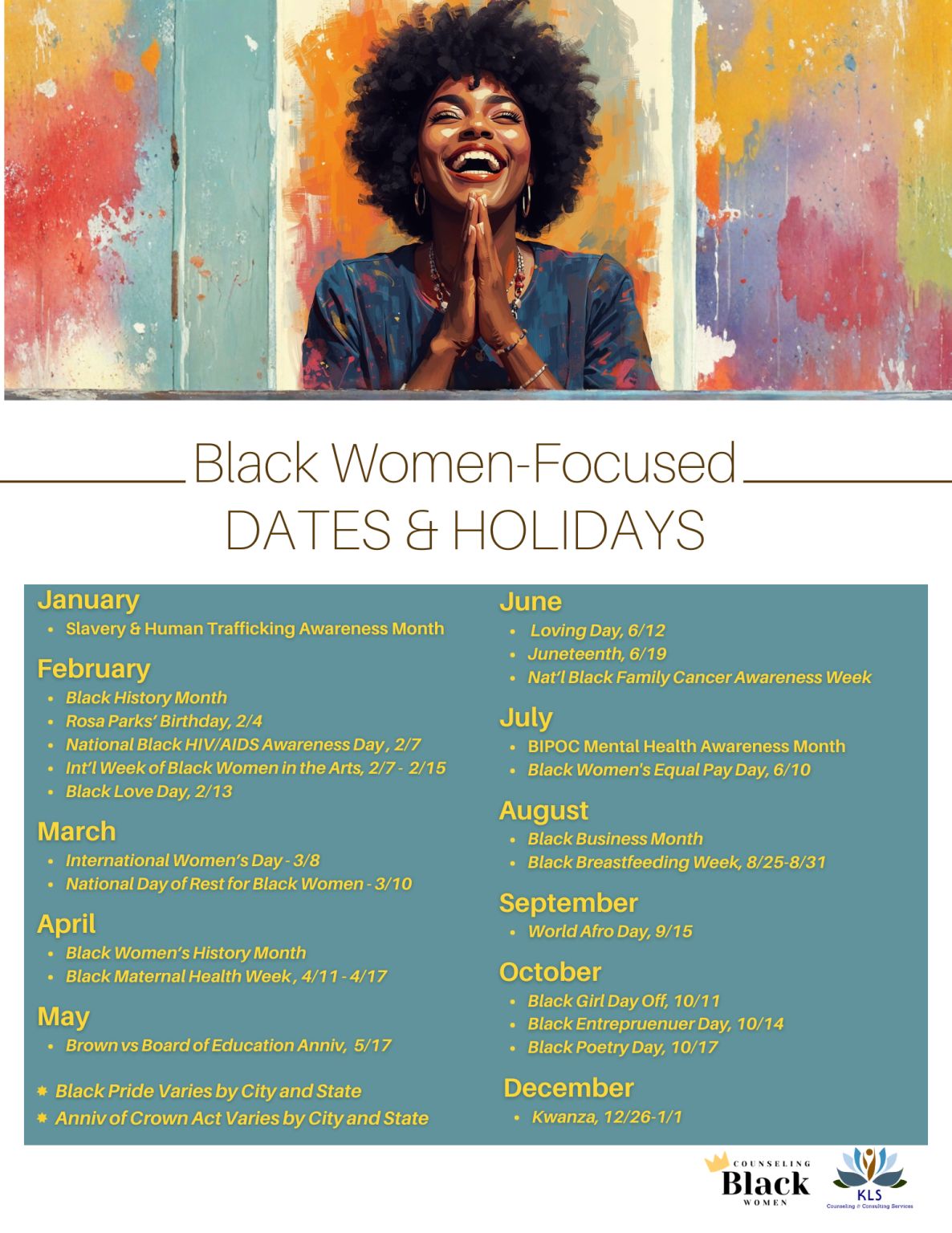
Cheat Sheet for Recognizing Black Women
This guidance is shared by Dr. Kimber Shelton, whose work continues to center the importance of culturally responsive approaches to mental health and well-being for Black women.
Below is a cheat sheet of awareness events and programs tailored for Black women, offering ways to better recognize, support, and center us throughout the year.
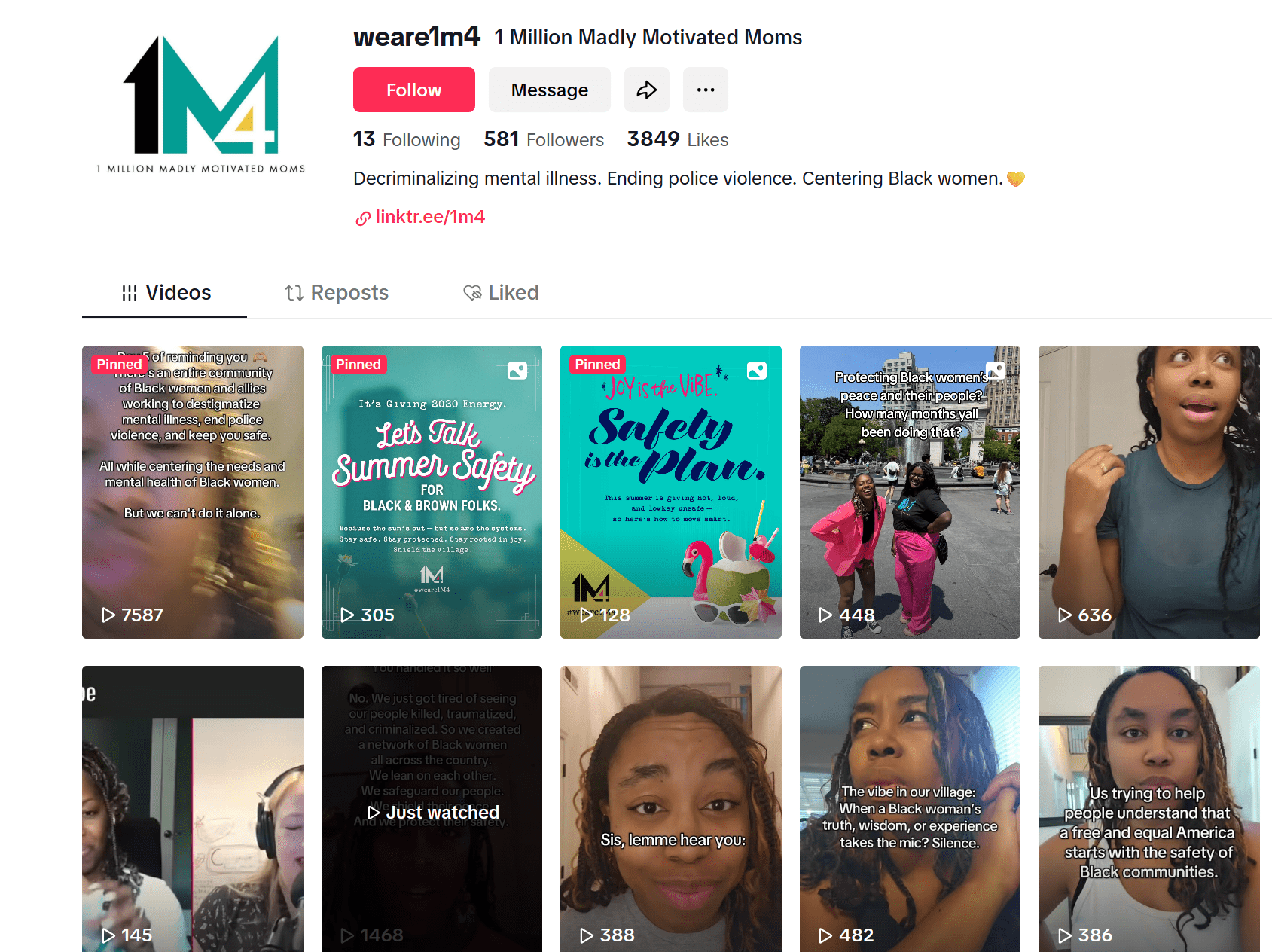
Ok so… we’re on TikTok now! Follow, engage, and rep 1M4 over there. We’re doing our best to reach the people.
Help some Sistas out!


You Got Your 1M4 Merch Yet?
Visit the 1M4 merch store to make sure you’re representing at court support, protests, or in line at your favorite coffee spot. We want to see YOU in your 1M4 gear. Every purchase goes directly to funding the work of 1M4 increasing access to safety and wellness.